
Sumter County Court Records After a Jail Arrest
Court records after a jail arrest start with the practical arrest path: law enforcement serves a warrant or makes an arrest, the person is booked into the Sumter County Sheriff's Office Detention Center, and the jail creates a custody record. That custody record may show the warrant type, statute text, arrest date, bond language, judge, held-for agency, cell block, and release date if release has been entered. It is useful, but it is not the same thing as the formal criminal case.
For the court side, use the Sumter Public Index, the South Carolina Judicial Branch case-search portal for Sumter County. The Public Index is where a reader should verify filed charges, court dates, case status, dispositions, and indexed filings. Jail custody details belong in jail inmate records, and booking-photo questions belong with jail roster mugshots. Court records after an arrest require both context points because booking text may be broader, earlier, or different from the charge later filed in court.
Arrest, Booking, Bond Court, and Filed Charges
The Sumter County pathway is local and specific. After arrest or warrant service, the person is taken to the detention center at 1250 Winkles Road. The jail creates the intake and roster entry. Bond court or first appearance then becomes the first formal court step for many arrests. The Sumter detention FAQ states that bond hearings are conducted Monday through Friday at 8 a.m. and 2 p.m. Weekend and holiday hearings are held as needed, with no afternoon sessions. The FAQ also warns that times can change at the magistrate judge's discretion and says to call 803-436-2340 to verify current bond-court timing.
After that early custody stage, charges move to the prosecution track. South Carolina uses solicitors rather than district attorneys. For Sumter County, felony and serious misdemeanor prosecutions in General Sessions Court are handled by the Third Judicial Circuit Solicitor's Office. The county solicitor page lists Ernest A. Finney III as Solicitor for the Third Judicial Circuit, serving Sumter, Lee, Clarendon, and Williamsburg Counties. The office is at the Sumter County Judicial Center, 215 N. Harvin St., Sumter, SC 29150, phone 803-436-2185, with public hours Monday through Friday, 8:30 a.m. to 5 p.m.
How to Find Court Records After an Arrest
The Public Index should be searched after gathering exact information from the jail record. Names can be entered differently across systems, and a roster charge can use warrant language rather than the final court wording. Start with the booked name, arrest date, charge text, statute number, warrant number, and any bond or judge text shown in the custody record.
- Open the Sumter Public Index.
- Search by defendant last name and first name. Use a case number, warrant number, or date range if the name is common.
- Open likely case results and review the charge list, case type, court dates, filings, and status entries.
- Compare each court charge to the jail roster text. Treat the court record as the formal case record, not as proof of conviction unless a disposition shows guilt by plea or finding.
| Search Field | Use | Notes |
|---|---|---|
| County or Site | Fixed Sumter portal path | The Sumter Public Index URL is county-specific. |
| Case Number | Exact case lookup | Useful when taken from a court notice, indictment, ticket, or prior filing. |
| Party Name | Defendant search | Use last and first name, then narrow common results with dates or case details. |
| Court or Case Type | Scope filter | Public Index coverage depends on the court and county configuration. |
| Date or Filing Range | Result narrowing | Helpful for older matters or common names. |
| Search or Submit | Runs the query | Review each possible result instead of relying on the first name match. |
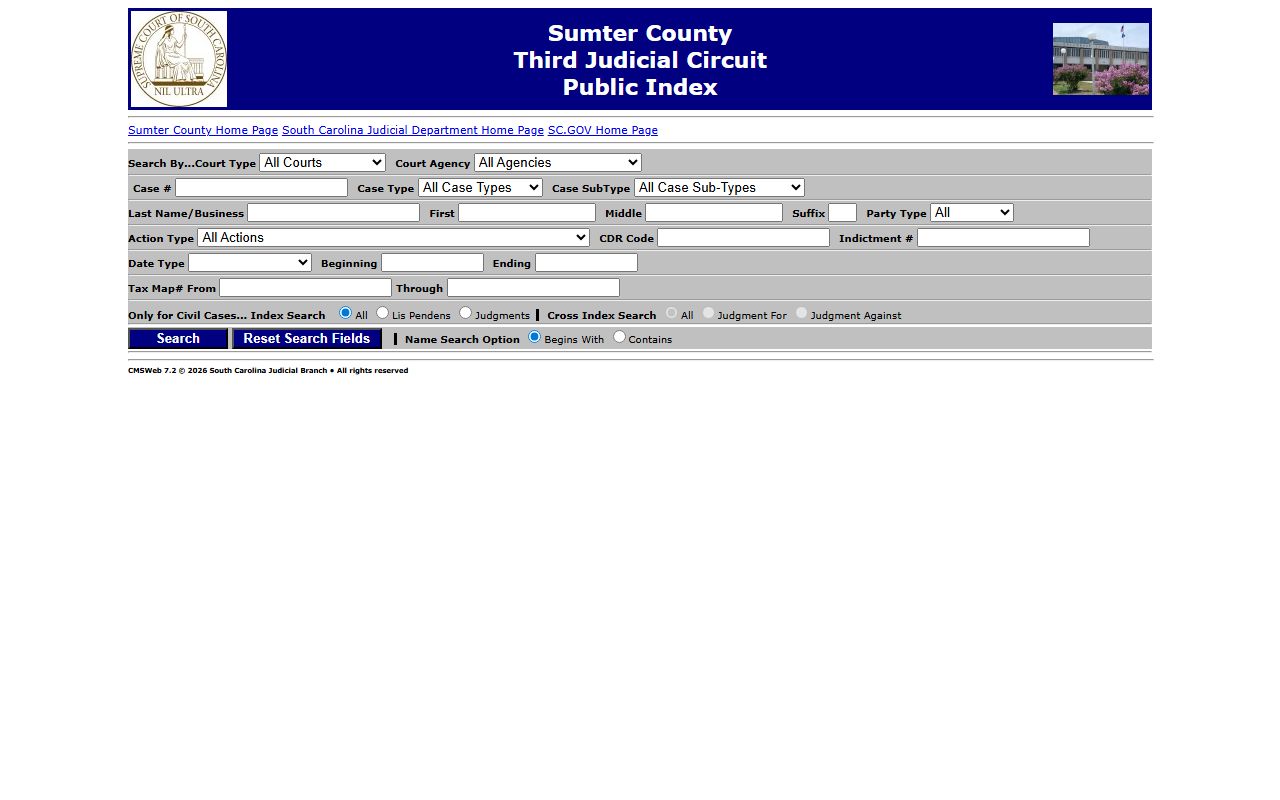
The screenshot below comes from the official South Carolina Judicial Branch Sumter Public Index case-search portal.
Charging Documents After a Jail Arrest
The document that starts or advances the court case can vary by charge type and court stage. A jail roster entry can show a warrant or hold reason before the final prosecution decision is visible. The solicitor may file or proceed on charges that differ from the original booking text, and a grand jury indictment may later become the controlling formal accusation for certain criminal cases.
| Document | Who Creates or Presents It | What It Means in Practice |
|---|---|---|
| Arrest Warrant or Bench Warrant | Issued through law enforcement or a court | Explains legal authority for the arrest or custody hold, but may not be the final filed charge. |
| Complaint or Ticket | Officer or charging authority | Often appears early in lower-level or initiating matters and can connect the arrest to a court file. |
| Solicitor Filing or Information | Prosecutor | Reflects the prosecuting office's chosen charge track after review. |
| Indictment | Grand jury process | A formal accusation used for certain criminal cases, especially serious General Sessions matters. |
Charge Status in Sumter County Court Records
Charge status is the reason a court lookup matters. A booking record may say "Awaiting Bond," "Not Required or No Bond," or list a warrant and statute. The court case can later show that the charge is pending, amended, reduced, dismissed, nolle prossed, or resolved by plea or verdict. Those terms are not interchangeable.
| Status | Plain-English Meaning | Record Caution |
|---|---|---|
| Pending | The charge has not reached final disposition. | It remains an accusation, not a conviction. |
| Amended | The filed charge changed after initial filing. | Compare the amendment to the booking charge and any indictment. |
| Reduced | The charge was lowered, often by plea or prosecutor action. | The final offense may differ from the arrest text. |
| Dismissed | The court or prosecution ended the charge without conviction. | Check whether expungement or sealing steps are separate. |
| Nolle Prosequi | The solicitor declined to continue prosecution. | This is not a guilty finding. |
| Disposition | The case outcome entered by the court. | Read the exact outcome before describing a record. |
| Conviction | A guilty plea or finding of guilt. | A conviction is different from arrest, booking, or charge filing. |
Bond Information Connected to Court Records After Arrest
Bond information sits between custody and court. The Sumter roster examples reviewed in the research included "Awaiting Bond," "Not Required or No Bond," and "Surety Bond or 10%, $25000.00; Set By Judge R. Richardson." The detention FAQ says a bonding agency must be contacted to initiate a surety bond, sheriff's personnel cannot recommend bonding agencies, and the bonding agency makes court arrangements for the discharge documents needed for release.
| Bond Term | Local Meaning |
|---|---|
| Awaiting Bond | Bond has not been set or entered yet. Check after bond court or call the jail. |
| Not Required or No Bond | May mean bond is unavailable or not required for that hold. Confirm with the court or jail. |
| Surety Bond or 10% | A bonding agency or listed partial-payment rule may apply when allowed by the court. |
| Cash or Full Payment | The Sumter FAQ does not document all accepted payment methods, so verify before relying on this option. |
| Hold or Detainer | Another warrant, court, agency, state, federal, or ICE hold may prevent release even if one bond is handled. |
Warrants That Lead to a Jail Arrest and Court Record
The Sumter County Sheriff's Office has a Civil Process warrants page, but the reviewed official sources did not show a public searchable active-warrant database comparable to the inmate roster. That matters because warrant information may become visible only after service, booking, or court filing. Observed roster records used warrant language, including warrant numbers, issuing jurisdiction, statute text, bond status, and judge information.
An arrest warrant authorizes an arrest on a criminal allegation. A bench warrant is issued by a judge, often for failure to appear, contempt, or violation of a court order. A Family Court bench warrant can involve family-court contempt or juvenile/family matters, where public access may be limited. A search warrant is different because it authorizes a search, not an arrest. Anyone concerned about an active warrant should contact an attorney, the issuing court, or the sheriff's office rather than appearing at the jail without understanding the arrest risk.
Charges vs. Convictions in Court Records After Arrest
A charge is an allegation. A conviction is a final guilty result by plea or finding. Public records can include both, so the distinction should be kept clear when reading Sumter County court records after a jail arrest. A person can be arrested, booked, and charged without ever being convicted. A charge can also be amended, reduced, dismissed, or nolle prossed before disposition.
| Issue | Charge | Conviction |
|---|---|---|
| Stage | Accusation or filed count | Final guilty outcome |
| Proof Level | Probable cause or prosecutor filing standard | Beyond a reasonable doubt or guilty plea |
| Where Seen | Roster, warrant, Public Index, filings | Disposition and sentencing entries |
| How to Describe It | Use charged, accused, pending, or filed | Use convicted only when the record shows conviction |
Sealed vs. Expunged Arrest and Court Records
South Carolina public-access law does not mean every arrest or court record remains visible forever. Section 17-1-40 addresses destruction or expungement of eligible arrest and booking records after certain dismissed, not-prosecuted, or acquitted outcomes. Title 17, Chapter 22 covers pretrial intervention and diversion, which can move some eligible cases out of the normal prosecution track with solicitor approval.
| Record Treatment | What It Usually Means | Sumter County Practical Step |
|---|---|---|
| Sealed | Public visibility is restricted by law or court order. | Verify the order with the court or clerk before assuming online access is complete. |
| Expunged | Eligible arrest or booking records may be removed or destroyed under the applicable order. | Confirm the expungement status through the court process, then use sheriff records channels for booking-record questions. |
| Juvenile or Family Matter | Access can be more limited than adult criminal matters. | Do not assume a missing record means no case exists. |
| Ongoing Investigation | FOIA exemptions may protect some law-enforcement material. | Expect redaction or withholding when Section 30-4-40 applies. |
Public Access Limits for Court Records After Arrest
South Carolina FOIA defines public records broadly and gives the public a right to inspect, copy, or receive non-exempt public records. For jail and custody records, Section 30-4-30 includes documents identifying people confined in a jail, detention center, or prison during the preceding three months among records that must be available for public inspection and copying during the public body's hours, unless an exemption applies. Section 30-4-40 lists exemptions, including certain law-enforcement records, privacy concerns, confidential sources, investigative techniques, and safety risks.
Record-use limit: Privately published jail, court, and roster summaries are not consumer reports under the FCRA. Do not use them for credit, employment, tenant screening, insurance, or any other FCRA-covered decision.